
Home insulation cost in 2026: types, R-values, and energy bill savings
Home insulation cost in 2026 runs $1,500 to $8,000 installed. Compare spray foam, blown-in, and batt with DOE R-values, tax credits, and 15% bill savings.

What does home insulation cost in a typical U.S. house heading into the 2026 heating season? Most homeowners pay $1,500 to $8,000 for a targeted retrofit, with attic-only work landing lower and whole-home closed-cell spray foam landing higher. The right choice depends on your climate zone, current R-value (the thermal resistance of an insulation assembly; higher numbers mean more heat blocked per dollar of material), and where warm air is actually escaping the building envelope.
How much does home insulation cost in 2026 by area of the home?
The average home insulation cost in 2026 falls between $1,500 and $8,000 for most retrofit projects, with new construction and whole-home closed-cell spray foam pushing above $15,000. Cost varies with square footage, insulation type, framing access, and whether air-sealing is bundled into the same visit.
Attic-only jobs are the entry point. Blown-in fiberglass or cellulose over an existing attic floor typically runs $1 to $2 per square foot installed, so a 1,000-square-foot attic lands near $1,500 to $2,000. Wall insulation is pricier because it requires either drill-and-fill through siding or open drywall access; expect $2 to $6 per square foot for injected foam or dense-pack cellulose. Crawl space and rim-joist work adds $1,500 to $4,000 depending on encapsulation scope. The Department of Energy insulation guide outlines where each assembly matters most.
Bundling improves your effective home insulation cost: crews already on site to blow attic insulation can seal top-plate penetrations and can-lights for a modest add-on rather than a full return trip. If you are also planning an attic conversion, sequencing insulation before finish work saves labor twice.
There is a full breakdown of this topic in Kitchen remodel cost 2026: cabinets, countertops, and labor guide.
There is a full breakdown of this topic in Foundation repair cost in 2026: cracks, settlement, and drainage.
We cover the details separately in Garage addition cost in 2026: attached, detached, and two-car options.
We cover the details separately in Water heater replacement cost in 2026: tank, tankless, and heat pump.
There is a full breakdown of this topic in Ductless mini-split cost 2026: single-zone and multi-zone systems.
We cover the details separately in Fence installation cost 2026: wood, vinyl, and metal breakdown.
We cover the details separately in Home generator installation cost 2026: standby, portable, fuel.
There is a full breakdown of this topic in Interior painting cost 2026: room prep, labor, and finish types.
Related reading: Deck construction cost 2026: materials, size, and labor pricing.
We cover the details separately in Bathroom remodel cost 2026: fixtures, tile, and labor breakdown.
Home insulation cost by type: spray foam, blown-in, and batt compared
Insulation type drives roughly 70% of your home insulation cost because material price and R-value per inch vary widely. Spray foam is the priciest and highest performing, blown-in cellulose or fiberglass hits the sweet spot for attics, and fiberglass batts remain the budget option for new construction and open cavities.
| Type | Installed cost | R-value per inch | Best use |
|---|---|---|---|
| Closed-cell spray foam | $2 to $5 per board foot | R-6 to R-7 | Rim joists, crawl walls, roof decks |
| Open-cell spray foam | $1 to $1.50 per board foot | R-3.5 to R-4 | Interior walls, sound damping |
| Blown-in cellulose | $1 to $2 per sq ft (R-30) | R-3.2 to R-3.8 | Attic floors, dense-pack walls |
| Blown-in fiberglass | $1 to $1.80 per sq ft (R-30) | R-2.2 to R-2.9 | Open attic floors |
| Fiberglass batts | $0.65 to $2 per sq ft | R-2.9 to R-3.8 | New construction, garages |
| Rigid foam board | $1.50 to $3 per sq ft | R-4 to R-6.5 | Basement walls, exterior sheathing |
The trade-off is speed and mess versus long-term performance. Spray foam finishes fastest and air-seals in one step but requires a 24-hour re-entry window and specialty crews. Blown-in cellulose is quieter and denser but can settle in walls if not properly packed. This Old House's insulation buyer's guide walks through each installation profile.
What R-values does the DOE recommend by climate zone?
The Department of Energy divides the U.S. into eight climate zones and publishes recommended R-values for attics, walls, floors, and basements in each. Colder zones need thicker assemblies; Chattanooga (Zone 4) and most of the Southeast fall in the moderate band, while the northern tier and mountain West sit in Zones 5 through 7.
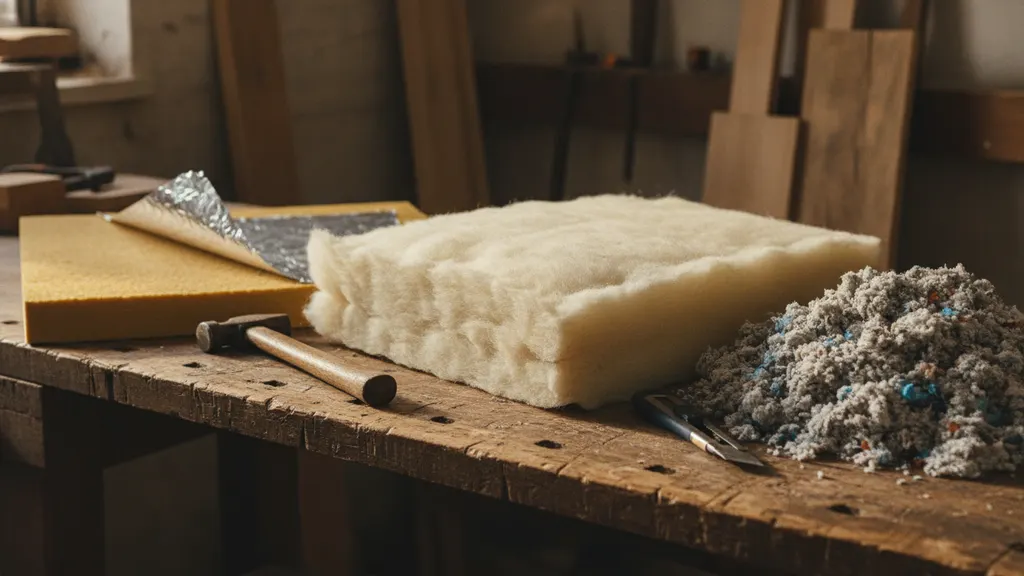
For attics, the DOE recommends R-30 to R-49 in Zones 1 through 3, R-38 to R-60 in Zones 4 and 5, and R-49 to R-60 in Zones 6 through 8. Walls in new construction should hit R-13 to R-21 in framed cavities, with continuous exterior foam adding R-5 or more in colder zones. Basement and crawl walls generally target R-10 to R-19. The DOE Energy Saver where-to-insulate guide lets you look up your ZIP code directly.
Existing homes rarely meet these numbers. A 1970s attic in Zone 4 often measures R-11 to R-19, well below current guidance. Bringing that up to R-49 typically requires 12 to 16 inches of loose-fill on top of what is already there, plus a check for adequate ventilation and baffles at the eaves.
Home insulation cost savings on your energy bills
Properly air-sealing and insulating a home cuts heating and cooling costs by roughly 15% on average, and by up to 20% in older, poorly insulated houses, according to Department of Energy Energy Saver Seal and Insulate guidance. On a $2,400 annual HVAC bill that is $360 to $480 back in your pocket every year for a decade or more. The EPA estimates that air leakage alone drives 25 to 40% of heating and cooling losses in a typical U.S. home, which is why the DOE treats air-sealing and insulation as a bundled home insulation cost upgrade rather than two separate line items. A house measuring 8 to 10 air changes per hour at 50 pascals of pressure (ACH50, the industry standard for rating whole-home airtightness) can drop to 3 to 4 ACH50 after a focused sealing pass, cutting infiltration losses by more than half before a single new batt or bag of cellulose is added.
Where the savings come from is often surprising. The EPA and DOE estimate that in a typical house, walls account for roughly 35% of heat loss, attic and roof 25%, floors and crawl 15%, and windows, doors, and infiltration the remaining 25%. That is why a home insulation cost calculation that only budgets for the attic can leave money on the table if the rim joists, basement band, and wall penetrations are ignored.
Federal tax credits and utility rebates for insulation in 2026
The Inflation Reduction Act extended the Energy Efficient Home Improvement Credit at 30% of insulation material costs, capped at $1,200 per year through 2032, per current IRS guidance. Labor does not qualify for the insulation line, but bulk insulation, air-sealing materials, and weatherstripping do. Homeowners claim the credit on IRS Form 5695 for the tax year the work was completed.
Utility rebates stack on top. Many electric cooperatives and gas utilities offer $0.10 to $0.30 per square foot for attic insulation upgrades that raise R-value by a documented amount, plus flat rebates of $200 to $500 for blower-door-verified air-sealing. The DOE weatherization portal links to state-level and utility programs. Contractors typically handle the paperwork if you ask up front.
If you are packaging insulation with other upgrades, the same $1,200 annual cap applies across doors, windows, and home energy audits, but heat pumps have their own $2,000 credit; see our heat pump installation cost guide for how those combine.
How to prioritize home insulation cost upgrades for the best ROI
The best sequence for lowering your total home insulation cost while maximizing energy savings is: audit first, air-seal second, insulate third, upgrade equipment last. A blower-door test (a calibrated fan sealed temporarily into an exterior doorway that quantifies whole-house air leakage in cubic feet per minute at 50 pascals, or CFM50) and infrared scan run $300 to $600 and pinpoint the actual leak locations, which almost always beats guessing. In a 1950s brick ranch I audited in Zone 5 outside Cincinnati, the pre-upgrade test logged 4,200 CFM50; after sealing the rim joists and topping the attic from R-11 to R-49, the post-test read 1,850 CFM50 and the homeowner's heating bill fell 19% the following winter.
Attic and rim joists usually top the priority list because warm air rises and those two assemblies leak the most in a typical U.S. home. That said, audits occasionally flip the script: in a 2001 Colonial I tested in Zone 5 near Columbus, the attic already read R-38 but the wall top plates and rim joists were wide open; redirecting the budget to those bypasses dropped the blower-door reading from 3,600 to 1,400 CFM50 in one visit and produced a larger first-winter bill reduction than a full attic top-up would have. Walls are next if you are already opening drywall for another project. Crawl space encapsulation is worth budgeting separately; see our crawl space encapsulation cost guide for scope and pricing. Windows are last per dollar spent: a full window replacement is rarely the most cost-effective envelope move, though it is the most visible.
For a whole-house strategy that pairs insulation with mechanical upgrades, our whole-home efficiency guide lays out the full stack. Skip any step and your effective home insulation cost per dollar of savings goes up because air leaks short-circuit the R-value you just paid for. Remodeling Magazine's annual Cost vs. Value Report tracks the resale side of the equation for major envelope work.
Frequently asked questions
How long does insulation take to pay for itself?
Most attic and air-sealing projects pay back in 3 to 7 years through lower heating and cooling bills, and closed-cell spray foam in cold climates pays back in 5 to 10 years. The Department of Energy's estimate of roughly 15% average savings on HVAC bills translates to $300 to $500 per year in a typical U.S. home, which recovers a $2,500 attic upgrade well within a decade. Homes that start with air leakage above 5 ACH50 see the steepest bill reductions after sealing because each additional ACH50 unit corresponds to a measurably larger conditioning load year-round. Your actual payback depends on climate zone, fuel source, and starting R-value; a blower-door test before and after gives you the cleanest number. See the DOE home energy audits page to book one.
Is spray foam worth the extra home insulation cost?
Closed-cell spray foam is worth the premium when you need air-sealing and insulation in one step, when the assembly is hard to access later, or when moisture control matters, such as rim joists, crawl walls, and unvented cathedral ceilings. At R-6 to R-7 per inch, it reaches code minimums in far less thickness than other products, which matters in tight framing bays and low-clearance assemblies where every inch counts. For an open, ventable attic with clear access, blown-in cellulose delivers similar R-value for a third of the price and is easier to top up later. Talk to a contractor who installs both before assuming spray foam is the answer everywhere. The Department of Energy insulation materials guide covers the trade-offs by assembly.
Can I add insulation over existing attic insulation?
Yes, in most cases you can blow new insulation directly over old fiberglass batts or existing cellulose as long as the old material is dry, uncontaminated, and free of vermiculite, which may contain asbestos and requires professional testing. Add loose-fill to bring the total depth up to the DOE-recommended level for your climate zone. Check for adequate soffit ventilation and install baffles at the eaves so airflow is not blocked. This Old House's attic insulation coverage walks through the layering process.
How do I qualify for the federal insulation tax credit?
To qualify for the 30% Energy Efficient Home Improvement Credit, the insulation must be installed in an existing home that is your principal U.S. residence, and the materials must meet the IECC energy code in effect two years before installation. You claim it on IRS Form 5695 for the tax year the work was completed, capped at $1,200 per year across the covered categories. Keep receipts that separate material cost from labor because labor for insulation does not qualify. The ENERGY STAR federal tax credit page tracks current rules if the IRS updates them.
Should I insulate before replacing my HVAC system?
Yes. Insulating and air-sealing first almost always lowers the required heating and cooling capacity, which lets you buy a smaller and less expensive HVAC system. An oversized system short-cycles, dehumidifies poorly, and wears out sooner. The DOE recommends a Manual J load calculation (the ACCA-standard sizing method that accounts for your home's actual envelope area, window-to-wall ratios, occupancy, and climate zone) after envelope improvements are complete. If you already know you are replacing equipment, get the insulation contractor and HVAC installer talking to each other before either quote is finalized so load numbers stay coordinated and warranties do not conflict.
What R-value do I need for walls in my climate zone?
For most of the U.S., the DOE recommends R-13 to R-15 cavity insulation in 2x4 walls and R-19 to R-21 in 2x6 walls, with continuous exterior insulation adding R-5 or more in climate zones 5 through 8. Colder regions such as the northern Plains and mountain West benefit from doubling up: cavity fill plus 1 to 2 inches of exterior rigid foam sheathing. The DOE Energy Saver ZIP-code tool gives the exact recommendation for your address, which is the answer local building inspectors will reference.
From our workshop
The work behind this
- Remodels & RenovationsTransforming lived-in homes with respect and artistry you can feel in every detail. We bring clarity to complexity, uncover what others may have covered up, and deliver spaces that feel completely renewed yet unmistakably solid.
- Custom Cabinets & KitchensHandcrafted in our Chattanooga workshop and installed by our own team, with options ranging from high-gloss finishes to solid oak, mahogany, and American walnut.


Thinking about a project of your own?
We start every job with a conversation. Tell us about your home and what you are imagining, and we will take it from there.
Book a Consultation