
Electrical panel upgrade cost in 2026: EV charging, solar, and safety
Electrical panel upgrade cost in 2026 runs $1,300 to $8,000+ depending on amperage, EV chargers, solar loads, permits, and rebates. Budget the right way.

Wondering what an electrical panel upgrade cost looks like before you sign a contract for an EV charger, a solar array, or a heat pump? Most homeowners land between $1,300 and $4,500 for a straight 100-to-200-amp swap, and the bill climbs higher once the meter base moves or the service drop needs work. This guide breaks the pricing down by scope, permits, and incentives so you can budget without surprises.
What drives electrical panel upgrade cost in 2026?
The electrical panel upgrade cost in a typical American home ranges from $1,300 for a straightforward 100-to-200-amp swap to more than $8,000 when the meter base must be relocated or the service drop replaced. JLC Online reporting on residential service work pegs a straight 200-amp panel change at $1,300 to $3,000 depending on panel brand, permit fees, and site access.
Three variables move that number the most: the amperage capacity you are moving to, the condition of the existing service entrance, and how far the panel sits from the meter and grounding electrode. A 200-amp service handles most modern homes with room to spare. A 400-amp service, common on properties adding EV charging plus solar plus a heat pump, adds a second load center and often needs a new meter can and mast.
Labor makes up 40 to 60 percent of a typical bill. Local licensed electrician rates range from $85 to $150 per hour in most markets, based on remodeling cost data from Remodeling Magazine. Permit fees add $75 to $500. Copper feeder wire, breakers, a surge protective device, and the panel itself account for the balance.
| Service size | Typical installed cost | Common upgrade trigger | Max grid-tied PV (120% rule) |
|---|---|---|---|
| 100A | Existing service (baseline) | Found in most pre-1980 homes; no upgrade needed | ~4 kW |
| 200A | $1,300 to $3,500 | First EV charger, heat pump, or solar array | ~12 kW |
| 320A | $3,500 to $6,000 | Dual EV charging plus battery backup | ~20 kW |
| 400A | $5,000 to $8,500+ | Full electrification, ADU, workshop, or pool | ~28 kW |
How EV chargers change your electrical panel upgrade cost
A Level 2 EV charger circuit adds $800 to $2,500 to your electrical panel upgrade cost in most U.S. markets, per the U.S. Department of Energy guide to home EV charging, because the dedicated 30-to-50-amp 240-volt circuit almost always triggers a panel capacity review before the utility will sign off.
A 100-amp panel can rarely absorb a full Level 2 charger without shedding another large load. Once you add up a 40-amp charger, a 40-amp electric range, a 30-amp dryer, and a 3-ton central AC, you are already past the 80 percent continuous-load ceiling that code allows for planning.
Three options cover most retrofits: install a smart splitter or load-management device to share an existing 240-volt circuit, keep the 100-amp service but shift loads to a subpanel, or upgrade to 200 or 400 amps. Smart splitters cost $500 to $900 installed. A full panel swap runs the numbers above but future-proofs the house for a second vehicle, a home battery, or a heat pump water heater. For homes planning charging and space heating changes together, our heat pump installation cost guide pairs well with this one.
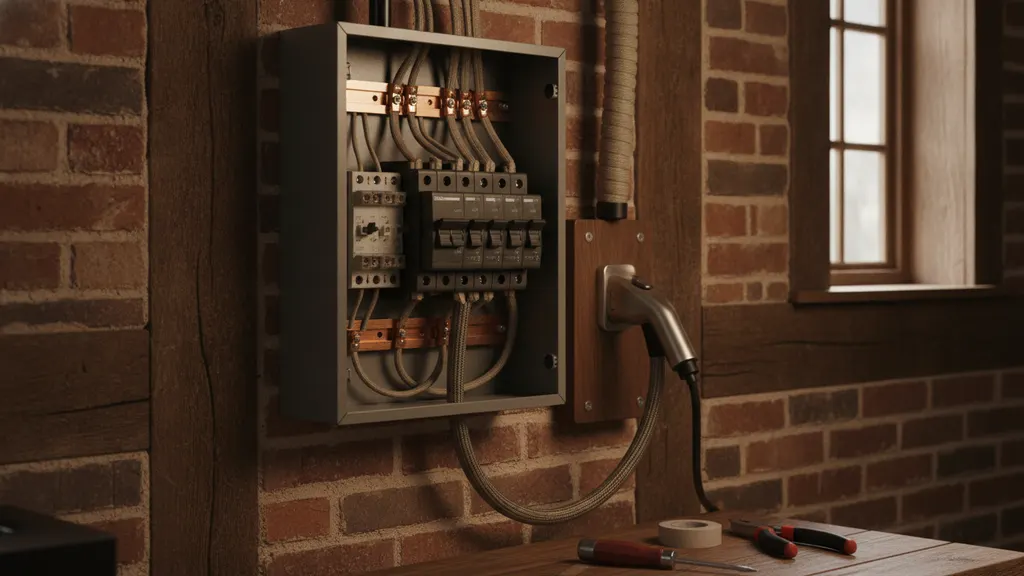
Solar, batteries, and the modern electrical panel upgrade cost
Rooftop solar and home batteries approach the electrical panel upgrade cost question from a different angle. A grid-tied PV system feeds current backward through your main breaker, and the National Electrical Code caps combined generation and utility feed at 120 percent of the busbar rating. A 100-amp panel with a 100-amp main breaker can accept only about 20 amps of backfeed, which limits you to roughly a 4 kW array.
Home batteries stack more constraints. Whole-home backup requires a critical-loads panel, an automatic transfer switch, and a grounded neutral separation from the main service. Most integrators quote $2,500 to $6,000 for the electrical work around a battery, on top of the panel itself. Partial-home backup, which powers only a small critical-loads subpanel, keeps the wallet lighter and the design simpler.
Three code paths cover most retrofits: a line-side tap ahead of the main breaker, a busbar upgrade to a higher-rated panel, or a full service upgrade to 200 or 400 amps. This Old House coverage of solar-ready electrical service explains why most installers now default to the third option on any home built before 1990.
Permits, inspections, and the electrical panel upgrade cost timeline
Panel work is one of the few projects where you cannot legally cut corners. Every jurisdiction requires a permit pulled by a licensed electrician, a rough inspection before drywall goes back up, and a final inspection before power is restored. The utility itself schedules the service disconnect and reconnect, which usually costs $150 to $400 and takes 2 to 4 weeks to book.
Coordination is where projects slip. The electrician needs the permit before the utility will schedule the cut. The inspector needs the panel grounded and labeled before signing off. The utility crew arrives inside a four-hour window and will not wait if the panel is not ready. Add these fees and lead times to your electrical panel upgrade cost planning from the start.
Expect a well-run project to take 6 to 10 hours of actual field work spread across 2 to 8 weeks of calendar time. Homes on overhead service run faster than homes on underground service. Meter base relocations add a full week and often trigger a mast rebuild that requires a separate structural permit.
Federal and state incentives that reduce your electrical panel upgrade cost
The Inflation Reduction Act Section 25C credit covers 30 percent of qualifying electrical panel work, capped at $600 per year, when the upgrade is tied to a specific efficiency improvement such as a heat pump, heat pump water heater, or EV charger installation. Keep the electrician invoice separate from the appliance invoice and file IRS Form 5695 with your return.
The IRA also created the High-Efficiency Electric Home Rebate Program, which routes point-of-sale rebates through state energy offices. Households under 80 percent of area median income can claim up to $4,000 toward panel upgrades tied to electrification. Rollouts vary, so check with your state energy office before you sign a contract.
| Program | Max benefit | Trigger requirement |
|---|---|---|
| IRA Section 25C | 30% up to $600/yr | Panel work tied to efficiency upgrade |
| HEEHRA (state-run) | Up to $4,000 | Income under 80% AMI, electrification project |
| Utility EV rebate | $250 to $1,500 | Level 2 charger plus approved panel |
| State solar credit | Varies | Interconnected PV system |
Local utilities add another layer. Many run their own EV charger and heat pump rebates that require a panel upgrade as a prerequisite. Stacked federal, state, and utility incentives can reduce your net electrical panel upgrade cost by 40 to 60 percent. Our whole-home efficiency upgrade guide shows how these programs stack across a full retrofit.
How to hire and screen a licensed electrician
A panel swap looks simple on paper. It is not. The wrong bid buys you a panel brand that is quietly being sued, a grounding scheme that will not pass inspection, or a service entrance that fails the first time a storm loosens the mast. Ask for the electrician license number, current liability insurance certificate, and manufacturer training records before you sign anything.
On a 1963 ranch-style we retrofitted in Thousand Oaks in the spring of 2023, the prior electrical contractor had installed an undersized Federal Pacific loadcenter with mixed breaker brands and no whole-panel surge protection. The utility refused to reconnect, the inspector failed the final twice, and the homeowner paid for two extra disconnect windows before the work passed.
Get three itemized bids on the same scope. Real bids break out the panel, breakers, surge protective device, permit, utility fee, and labor as separate line items. A single lump sum tells you nothing and hides the real electrical panel upgrade cost from you.
Reference-check the last three panel jobs. Ask each reference whether the electrician pulled the permit personally, whether the inspection passed on the first visit, and whether the final walkthrough matched the bid. The National Association of Home Builders homeowner resource center publishes a checklist for vetting trade contractors. For projects tied to appliance loads such as an induction range or oven bank, cross-reference our kitchen remodel cost guide to size the service correctly the first time.
Frequently asked questions
How long does an electrical panel upgrade take?
Field work usually takes 6 to 10 hours in a single day once the crew is on site, but the calendar timeline runs 2 to 8 weeks. That covers the permit application, the utility disconnect scheduling window, the swap itself, the rough and final inspections, and the utility reconnect. Homes on overhead service move faster than homes on underground service because the utility crew does not need to dig. Meter base relocations add a week and often trigger a separate mast permit. Most utilities require a minimum 48-hour advance notice for the service cut, and during peak demand seasons that booking window can stretch to six weeks or more in busy markets. Book the utility disconnect first, because that slot drives every other date, per U.S. Department of Energy residential service guidance.
Can I install an EV charger without upgrading the panel?
Sometimes. A licensed electrician runs a service-load calculation per NEC Article 220. If your existing 100-amp or 150-amp panel has enough headroom after accounting for HVAC, water heating, cooking, and dryer loads, you can add a 30 to 50-amp Level 2 circuit. Many homes do not have that headroom once continuous-load safety factors are added. Smart splitters and load-management devices offer a middle path by sharing a circuit with the dryer or range, and they are approved under the 2020 and later National Electrical Code. The continuous-load rule in NEC Article 210.19 requires the circuit conductor and breaker to be rated at 125 percent of the charger's draw, so a 48-amp charger needs a 60-amp circuit. Confirm with the utility before ordering hardware, per DOE home charging guidance.
Is 100-amp service enough for a modern all-electric home?
Rarely. A modern all-electric home with a heat pump, heat pump water heater, induction range, electric dryer, and a Level 2 EV charger typically calls for 200-amp service at minimum. A 100-amp panel can work in a smaller home with gas cooking, gas water heating, and no EV, but adding any two electric appliances usually pushes the calculated load past the 80 percent ceiling. Load-management devices help stretch a 100-amp service, but they are a bridge rather than a permanent answer, according to This Old House electrical guidance. DOE residential electrification modeling puts peak coincident demand at 14 to 18 kW for the average home running a heat pump and EV charger at the same time, well above what a 100-amp service can carry under NEC Article 220 load calculations. Plan for 200 amps if you expect to electrify further.
What is the difference between 200-amp and 400-amp service?
A 200-amp service delivers 48 kW of continuous capacity at 240 volts. That supports a heat pump, EV charger, induction range, and a modest solar array in most homes. A 400-amp service, usually built with two 200-amp panels fed from a single meter, supports two EV chargers, a larger solar array with battery backup, a hot tub, an accessory dwelling unit, or a small workshop. The 400-amp upgrade typically doubles the material cost and adds 30 to 50 percent to labor, per Remodeling Magazine cost data on service upgrades. NEC Article 230.79 sets the minimum residential service at 100 amps for new single-family homes, but most jurisdictions with active electrification programs now recommend 200 amps as the practical floor for any household planning EV charging or a heat pump within five years. Right-size the service to the ten-year plan.
Do I need to be home during the panel upgrade?
Yes, at least for the utility disconnect and reconnect windows. Power to the whole house will be out for most of the workday, so plan for it. Refrigerator contents should move to a cooler, and any pumped or medically necessary equipment needs a backup plan. Some jurisdictions require the homeowner present for the final inspection, particularly when the meter base moves. Confirm with your electrician and inspector at the pre-construction walkthrough. Many utilities will not restore power without an authorized adult present to sign the reconnect paperwork, and a missed window can push restoration back 24 to 72 hours, particularly on weekends or during high-demand periods. A well-prepared homeowner speeds the crew and helps avoid a callback fee, per NAHB homeowner project guidance.
Does homeowners insurance affect your electrical panel upgrade cost?
Coverage depends on the brand and the insurer. Panels from Federal Pacific, Zinsco, Challenger, and certain Pushmatic models are widely refused for new policies and quietly non-renewed at existing homes because of documented fire-risk history. Your carrier can force a panel replacement as a condition of continued coverage. Fire and liability claims tied to a known-defective panel can be reduced or denied. Some carriers add a 10 to 15 percent surcharge on the annual premium before deciding to non-renew, so confirming the panel brand before your next renewal can shape the timing and scope of any replacement. Ask your insurance broker to check the panel model at your next renewal, and factor the replacement into your electrical panel upgrade cost planning if the brand is flagged, per DOE panel-safety reporting.
From our workshop
The work behind this
- Remodels & RenovationsTransforming lived-in homes with respect and artistry you can feel in every detail. We bring clarity to complexity, uncover what others may have covered up, and deliver spaces that feel completely renewed yet unmistakably solid.
- Custom Cabinets & KitchensHandcrafted in our Chattanooga workshop and installed by our own team, with options ranging from high-gloss finishes to solid oak, mahogany, and American walnut.


Thinking about a project of your own?
We start every job with a conversation. Tell us about your home and what you are imagining, and we will take it from there.
Book a Consultation